
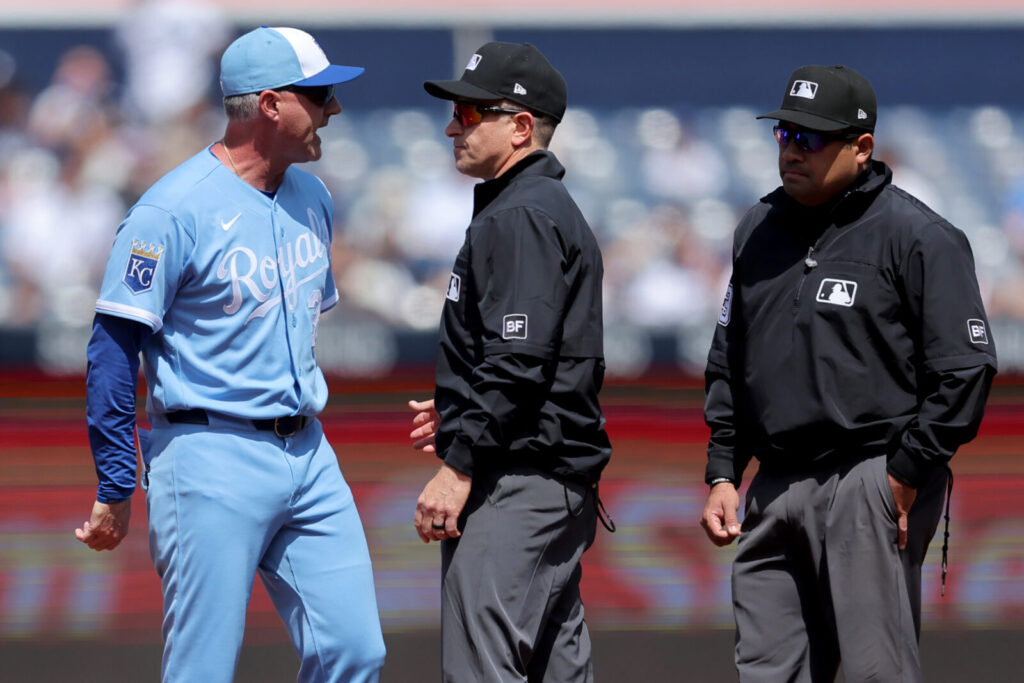
This is probably a strange way to begin, but I want to start by saying that I don’t believe what I’m about to argue should matter very much. Or maybe at all.
You see, I’ve been engaged in the debate around an electronic strike zone for nearly 15 years. I’ve learned a few things along the way. The biggest is that the conversation is best had on the facts. Attempts by either side to appeal to emotions and intentions are counterproductive at best.
In my earlier, more fiery days, I was inclined to bemoan the veteran pitcher getting a wide zone against a rookie hitter. I would point out how often the misses would go in favor of the big market teams with the superstar players. And against the league’s proverbial punching bags. It was easy and fun to point out what I believed were “make-up” calls.
But that’s all noise that muddies the conversation. As are their opposites; Appeals to the quality or feelings of the umpire. Yet, these are the most common arguments made by critics of the new ABS system. Appeals to emotion. There has been progress, though.
A New Day
Gone are the days of insisting that a strike is whatever the ump says it is. MLB gave that fight up when they began using the tech to evaluate umpires behind the scenes. Gone are the days of giving 3-0 strikes on pitches that were “close enough.” And gone are the days when the answer to every missed call was “there’s nothing you can do about it.” We invented a thing for just that purpose.
So, now that we can do something about it, challenge and overturn, how has the conversation changed? Sadly, not much yet. But there is one massive and extremely important difference. Now, facts are at the center.
We have data. We have data on every missed call. Every challenge. Every overturn. There are even already metrics that help show the value of each challenge. No longer can all of this be hand waived with old sayings like “they get more than they miss” or “it all balances out in the end.” Let’s see.
Numbers Don’t Lie?
But before we get to the numbers, let us reexamine the two points I hear most from critics of ABS and EKZ. Or those who believe we should make no more reforms. They are typically phrased as some form of the following two questions. Do we have to embarrass the umpires? And can’t we at least admit that most of them get most of the calls right?
In other words, we must begin with the premise that all, or certainly most umpires, are good.
It’s a curious claim to make. Especially without evidence, which is the case much of the time. But there are those who will provide evidence. Some, anyway. If you’ve listened to enough broadcasts on TV or radio, you have almost certainly heard someone say that umpires get “90-plus percent of the calls” right. And, you know what? That’s spot on.
Now, it hasn’t always been this way. Research dating back to 2008 shows that the percentage of missed calls used to sit closer to 16% (84% correct) and has steadily gotten better each year. One might notice that this improvement is in direct correlation to machine evaluation. You could easily make the case that Hawkeye tech was improving the strike zone well before ABS.
Whether it’s a coincidence or not, umpires have been at their best as scrutiny has grown. One needn’t look any farther than this year where only three MLB umps are below 90 percent success rate on calling balls and strikes.
Taking a look at this table from TaptoChallenge.com, we can see that even the “worst” umpires are way better than the average used to be.

We can also see that the umpires with the worst accuracy ratings are spending fewer games behind the plate. This is good and hasn’t always been the case. It’s another positive change thanks to the information we have gathered through technology.
While we’re giving credit where it’s due, check out these top performers:

So, you might be asking, if the vast majority of umpires are getting 90-94 percent of the calls right, and the best are at a whopping 96 percent, do we really need to be doing all this? Or even if we do, can’t you just admit the umpires are…good?
Not to sound like a politician but what is… good? Let’s get back to that.
Best in the World
First, there are a few things we can say for sure given the data presented. These umpires are the absolute best in the world. Furthermore, they are the absolute best in the history of the world. It’s also hard to imagine them being much better. As many who have long resisted change often point out, it’s a very difficult job to do. The higher the velos and spin rates go, the harder it gets.
So, it is safe to say that the people currently doing an incredibly difficult job are the best to ever do it.
Here’s the problem. At no point in MLB history, thanks largely to people who have wanted to avoid conversations about umpires altogether, we have completely avoided parameters that tell us what good and bad actually are. Ninety percent success rate sounds great! Until you’re talking about your pilot’s landing record. Context matters. Of course, calling balls and strikes isn’t life or death so let’s use a baseball example.
Almost all of us baseball fans have, at one point or another, waxed poetic that in our sport even the best of the best fail most of the time. Getting a hit 33 percent of the time might sound terrible to a layman. But we know that can get you in the Hall of Fame. Giving up two runs every nine innings might sound bad. Until you have the context.
How about a more direct comparison? How about a baseball number where 90 percent success, even 95 percent success, is considered bad? Fielding percentage.
Last year, St. Louis shortstop Masyn Winn played 129 games and made only three errors. Only three mistakes. His fielding percentage was .994, best in the league. At the other end of the spectrum is Cincinnati’s Elly De La Cruz. He played 158 games and made 26 errors. His fielding percentage? .955.
Was Elly a surehanded defender because he made 95 percent of the plays? Or do we quite rightly recognize that as poor performance? When it comes to overall defense, we have much better numbers these days to evaluate players. But fielding percentage shows how there can be a pretty big difference between 99 and 95 percent. Can you imagine a shortstop fielding at 90 percent? Is that theoretical player… good?
In one context (batting average) 33 percent is excellent. In another (fielding percentage) 95 percent is terrible. What is the context for the umpire?
Perhaps the point I’m getting at here is best illustrated through a different statistic. One that has become much more a part of the modern parlance, WAR. Inherent in WAR is the concept of a replacement player. This is more of an idea than a person. It’s a middle point that lets us know that above this mark is “good” and below is not so good.
What is WAR for an umpire?
We don’t know. We have never established a working parameter or baseline. There is no way to say that the umpires are good if there is no way to say that they are bad. Or mediocre for that matter. We need parameters. But we likely won’t ever get them.
Because now we have the technology to get every single call right. Now, the replacement player is a perfect machine. Which means 90 or even 95 percent pales in comparison to what it could be. What it arguably should be. One hundred percent.
The Human Element
There are those who say that to correct the remaining five-to-ten percent is to remove the “human element” from the game. I say poppycock. Look no further than the top of the eighth inning, Los Angeles Dodgers vs. Colorado Rockies at Coors Field Saturday night.
Jaden Hill is pitching for the home club, clinging to a one-run lead. He’s a young reliever with fewer than 50 innings pitched in his career. He has yet to establish himself in MLB. His first task is to face maybe the greatest baseball player ever sent to Earth. Shohei Ohtani.
On a two-strike pitch, he appears to beat the MVP with a high fastball, but Ohtani’s bat makes contact with catcher Hunter Goodman’s glove. Human element. Error. Take first base.
The next batter, Kyle Tucker, hit a low line drive at 85 MPH right near where the shortstop normally plays. But because of a shift, the ball cleared the infield for a single instead of the double play. More human element. Though, this time informed by the machines that tell them where to shift.
Next up, with two outs and nobody on, was Andy Pages. Pages has an OPS of 1.061 and according to Baseball Savant is in the 97th percentile for most valuable hitters in MLB. He’s one of the absolute best hitters on the planet right now.
Hill began by missing with a change-up. Then came right back with a pair of dynamite sinkers, inducing a pair of foul balls to move the count to 1-2. Then he threw this slider:

Dan Iassogna, who sits near the top of the charts in terms of total missed calls, missed the call. It wasn’t close. The entire ball is in the zone.
A 119-loss team against the defending champs with all that going against them. The last thing Jaden Hill needed in that moment was more “human element.”
In any other year, this would have given one of the best hitters on the planet a 2-2 count. As someone who has covered the Rockies for 14+ seasons, I can tell you that quite often the next pitch would have been put into the gap and effectively won the ballgame for the Dodgers. Of course, we can’t know this would have happened to Hill. Not for sure.
What we know is that we don’t have to live in the world where we found out. We live in a world where, in an instant, Goodman tapped his helmet, reversed the call and swung the momentum of the inning. The phenomenal hitter didn’t get a fourth strike. He walked back to the dugout. Hill escaped the jam without allowing a run. The Rockies held on to win by one. After the Tucker single, the Dodgers had a win probability of 47 percent. After the Pages strikeout, it went down to 35 percent.
A perfect strike zone does not remove the human element from baseball. It enhances it. Jaden Hill deserved his moment. More than that, he earned it.
This is why I began this piece by saying that I don’t think the argument of whether or not the umpires are “good” should matter. It shouldn’t be the first question in every segment on the subject. The honest answer is that we don’t know. We just know the machines are better.
Why So Serious?
So why is the conversation so often framed this way? Why is the incredibly ambiguous notion of how “good” they are or how “embarrassed” they feel brought to the forefront?
For far too long, those of us who only wanted fairness were treated as though we were the emotional ones. Our feelings were just hurt because our favorite team lost. We were blaming the umps because we were mad. Emotions, often assigned to us whether we felt them or not, were reasons for dismissal. Not just of our arguments, but of the data. It was a dismissal of the information that now shows we were right all along.
A lot of calls are still missed, by the way. A 90 percent success rate still amounts to thousands of misses. And just one, in just the right (or wrong) moment, can swing the tide of a game. Just ask Jaden Hill.
We’ve already seen multiple game-changing overturns in 2026. A game has even ended on an ABS challenge. This is a sport where as long as you have outs, you have a chance. These are huge overturns.
So of course people are mad when calls still get missed because a team ran out of challenges. Naturally, they feel vindicated each time a call is changed. We can’t help but wonder how many over the years might’ve been different. How many times we were told we were just being emotional. And that those emotions didn’t matter.
The Facts of the Case… And They Are Undisputed
For far too long umpires had zero accountability. Now they have but a small modicum. And, apart from maybe CB Bucknor, nobody is calling for jobs. Just for mistakes to be corrected. So, let’s pump the brakes with the emotion policing.
To that end, I found this video to be both puzzling and encouraging. On one hand the speaker, Brodie Brazil, gives an open-minded, articulate take on the issue. But around the three-minute mark you can see as he, almost in real time, realizes that presenting a graphic of missed calls isn’t… for lack of a better word… a mean thing to do. The same way it’s not mean-spirited to have a graphic of the worst-hitting left fielders so far this season. Or lowest fielding percentages.
These are just facts. If you’re embarrassed by facts, do what we were told to do about missed calls for decades; just get over it. Don’t let your emotions get the best of you.
For far too long it has been assumed that people advocating for a fair strike zone are doing so out of some kind of maliciousness toward the umpire. Indifference to emotion in the face of facts is not maliciousness. Now that we are winning the argument and slowly starting to see the changes implemented, objectively for the better, we are being scolded to make sure we have the right temperament toward the most protected people in the game.
There is no conversation about player performance, or front office decisions, that begins with the feelings of those involved. Players and coaches are human, too.
Yet we are able to divorce ourselves from the notion that criticizing their performance is tantamount to hurling personal insults. Even when they are traded mid-season and have to move their entire families across the country, we are told it’s not personal. We have to explain to our five-year-olds why their favorite player doesn’t play here anymore. “It’s a business,” they say. We can do the same for umpires. It’s not personal. It’s a business. And it’s not their jobs on the line. It never has been.
Still Not Getting the Calls Right
Remember. Feel. Find empathy. Not for the players. Or the manager. Not for the GM. If you find empathy for an owner, the internet will arrest you. Empathy in baseball is for one group of people.
We must be kind to the umpire. Consider their emotions. We must put aside our own. Our emotions are reason for a dismissal of the facts, their emotions are reason for reflection. They will tell us here, and here, and here, and here. Oh, and also here and here. Tip of the iceberg. All the big shows and broadcasts will remind us, many with umpires going on record, that we shouldn’t hurt their feelings. Feelings are important. Then they will segue to a blooper reel of the worst fielding mistakes this week. And laugh.
Many will say they embrace this new reality but tell us that we shouldn’t rub the umpire’s noses in it. I agree. The point of the system should not be to embarrass anyone. It should be to get as many calls correct as possible. Unfortunately, we created a system that is only correcting about 21 percent of missed calls while doing more to embarrass umpires than anything else in history.
It isn’t the goal of ABS to embarrass anyone. It just happens to be the result.
Now that we’ve crossed this threshold, the only way to completely remove embarrassment from the equation is to completely remove umpires from the process of calling balls and strikes.
Whether they are “good” or not.