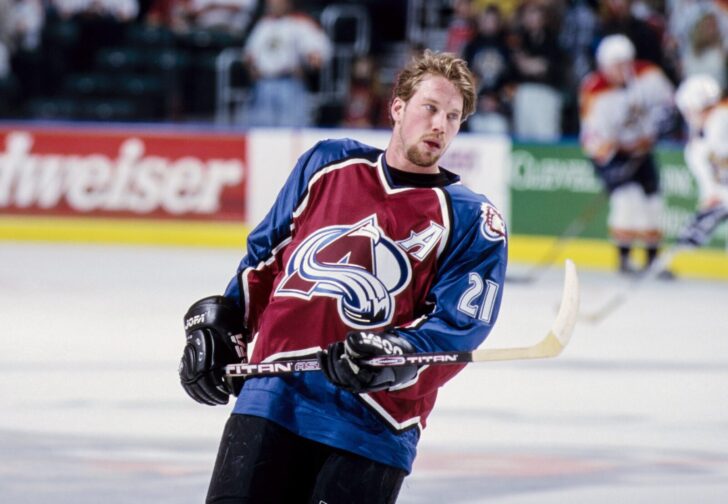
The Colorado Avalanche is going to honor its 1996 Stanley Cup championship team with a celebration at the Paramount Theater in downtown Denver on Wednesday, December 10, and then also the next night at Colorado’s home game against the Florida Panthers.
That storybook season, the hoist-the-Cup ending and parade all were part of Denver’s first-ever major league championship in the first season after the franchise hurriedly was transplanted from Quebec to Colorado in the summer of 1995.
To celebrate, Mile High Sports is proud to offer this excerpt from part of Terry Frei’s memoir, “Playing Piano in a Brothel”.
***
I was working for The Sporting News and had moved back to Denver when the news broke in June 1995 that the Quebec Nordiques were being sold to COMSAT and relocating to Denver. The real plan had been for the Nuggets’ ownership, COMSAT, to help provide leverage for Nordiques’ ownership as it sought a new arena to replace the undersized and out-of-date Colisee in Quebec City. COMSAT would earn the gratitude of the league and move to the front of the line for an expansion franchise, preferably to begin play after the opening of a privately financed Denver arena on the drawing board at the time. But Quebec officials wouldn’t be bullied into
building the Nordiques a new arena and Denver suddenly was back in the NHL after a thirteen-year absence.
I attended the Avalanche’s home opener, against the Red Wings, as a Sporting News staffer and wrote a short piece for the front of that week’s magazine about the return of the NHL to Denver. A few weeks later, I agreed to return to the Denver Post, to cover the NHL at-large and also to help Adrian Dater cover the Avalanche but with the additional understanding that I would be the relief columnist and operate as a feature writer and versatile reporter deployed on virtually all sports and beats. We also agreed I would remain affiliated with the Sporting News and get spot assignments from the magazine. In the next few years, I was called out of the TSN bullpen for
events such as the Fiesta Bowl and Super Bowl and to write other pro and college football stories before I signed on with ESPN.com.
Meanwhile, I — and everyone else — knew right off that this wasn’t Rocky Hockey. In the lockout-shortened 1995 season, the Nordiques had the best record in the Eastern Conference but lost in the first round of the playoffs to the New York Rangers. Center Joe Sakic was the young captain. Babyfaced Swedish center Peter Forsberg had just won the Calder Trophy as the league’s rookie of the year and already showed his ability to take over games while refusing to be knocked off the puck. Marc Crawford, a feisty former utility forward with Vancouver, had just won the Jack Adams Trophy as the league’s coach of the year in his first year as an NHL coach.
COMSAT officials hadn’t expected to find themselves with a hockey team so soon. The situation reminded me of Robert Redford at the end of The Candidate. As a newly elected senator who has compromised his idealism during the campaign, he asks, “What do we do now?” COMSAT wisely took advantage of the marketing staff already in place for the Nuggets and let general manager Pierre Lacroix, only a year removed from his long career as a player agent before moving to the other side of the table, operate as if the hockey team was his — within more budgetary constraints than some of Lacroix’s critics acknowledged.
I still was on the Sporting News payroll and working on a story about Ohio State football — I was supposed to advance the argument for the Buckeyes being the number one team in the nation, an argument made moot when they lost to Michigan in the final regular season game with the issue still on the newsstand — when Avalanche official Jean Martineau called me in Columbus. He introduced himself and informed me that Colorado had traded winger Owen Nolan to San Jose for defenseman Sandis Ozolinsh, whom I soon came to think of as the “Wandering Latvian.” The deal was billed as providing the Avalanche a sorely needed second-wave contribution from the blue line, and it turned out to be perhaps the most underrated deal of Pierre Lacroix’s tenure.
Given my background with the Rockies, I always was convinced that a winning NHL team would be a big draw in Denver — both in the days of yore and in the mid-1990s. Yet I was a bit surprised by how fast the Avalanche caught on. When they drew a full house of 16,061 for the ninth home game of the 1995–96 season, little did we know that it would be the start of the longest recorded sellout streak in NHL history. The undersized McNichols Sports Arena had something to do with it, but there was no question that the new NHL team quickly became a hot ticket.
For my first story, I profiled Claude Lemieux, the controversial winger who had joined the Avalanche in early October in a trade with New Jersey, for whom he had won the Conn Smythe Trophy as the league’s playoff MVP for the champion Devils. I laughed after I asked Forsberg about his new linemate. “He’s a little dirty player, and I like that,” Forsberg told me. “He’s a goal scorer and a defensive player, and I can’t complain about playing with him. He gets people upset and all that, eh?”
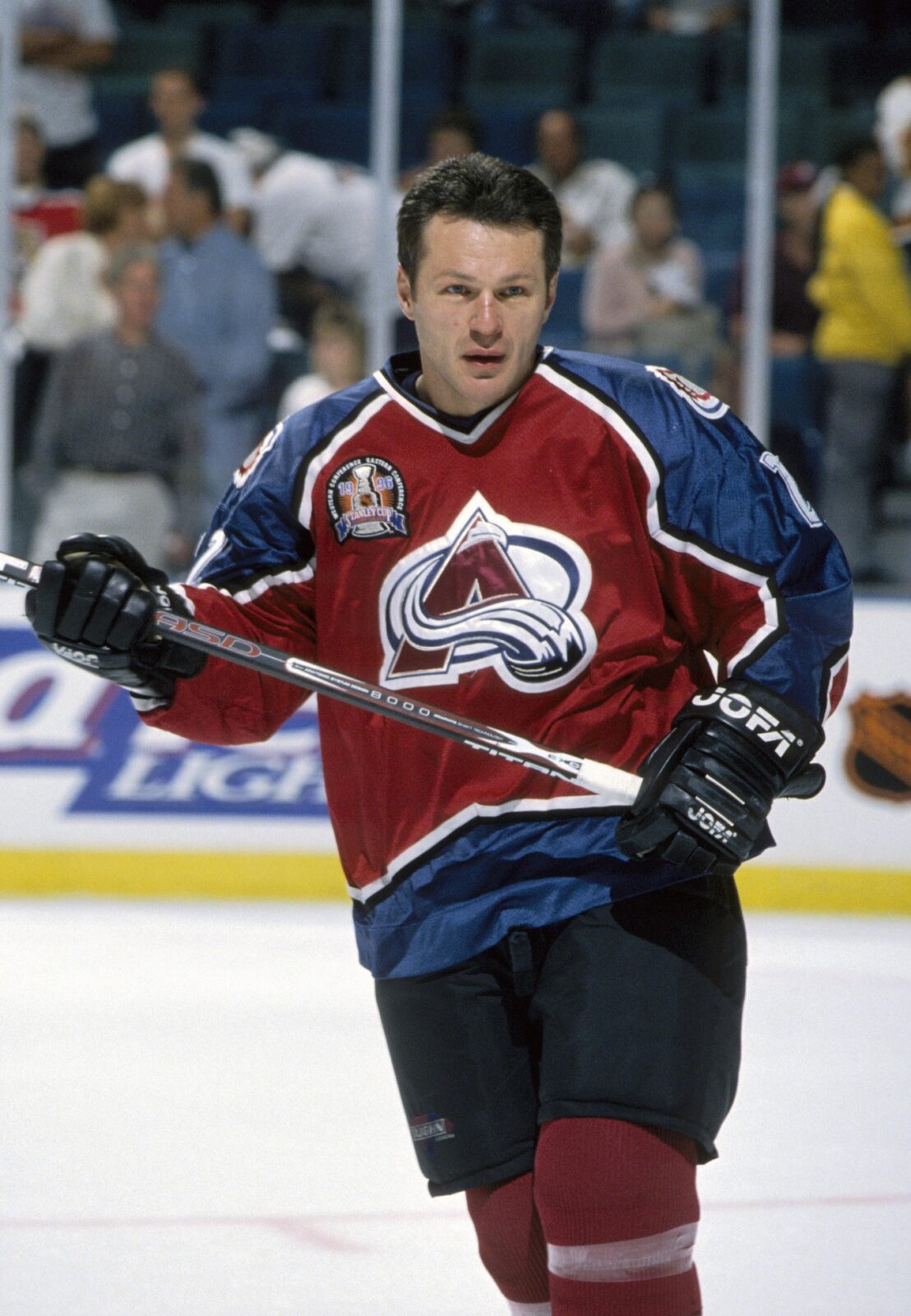
Unknown Date; Miami, FL, USA; FILE PHOTO; Colorado Avalanche forward Claude Lemieux (22) ) prior to the match against the Florida Panthers at the Miami Arena during the 1996 season. Mandatory Credit: USA TODAY Sports
One of the reasons I laughed was that although Forsberg had been in North America less than a year, he had started to sound like a Canadian.
Even then, with Lemieux playing on the line with Forsberg and Russian Valeri Kamensky, I found Lemieux to be one of the most interesting athletes I had encountered, mainly because of the conspicuous contradictions. Then a soft-spoken, thoughtful thirty year old, he was known to yap on the ice in the manner of the playground brat we all hated and to take cheap shots and run. He often was considered as selfish and annoying by his Montreal and New Jersey teammates (“Le Me” was one of his dressing room nicknames) as he was by his disdainful opponents.
The Avalanche got off to a good start that first season, but the major question mark remained their goaltending, with young Stephane Fiset and Jocelyn Thibault alternating. Then came the infamous Patrick Roy implosion in Montreal. Roy, who twice had won the Conn Smythe Trophy as the playoff MVP, was the best “money” goalie in the game and at the time had just turned thirty. The Canadiens got off to a horrible start that season, leading to the firings of general manager Serge Savard and coach Jacques Demers. The new coach was Mario Tremblay, whose relationship with Roy had been rocky as teammates when Tremblay was a veteran winger playing in front of Roy. With the Canadiens struggling, Roy was impatient and cranky and couldn’t hide it, so much so that even Roy backers wondered if his temperament made him intolerable in losing situations.
Before the Canadiens’ December 2 game at home against Detroit, Roy was angry when high-scoring winger Vincent Damphousse showed up only ten minutes before the warm-up and Tremblay let it slide. Roy challenged Tremblay about it, asking if he would treat rookie winger Yves Sarault the same way. A little later, Tremblay left Roy in for the first nine Detroit goals in an 11–1 Montreal loss, and Roy — backed by the conventional hockey wisdom that dictated that you remove your goalie amid such onslaughts — took that for the affront it was. On the bench after finally being yanked, he squeezed past Tremblay and approached Canadiens president Ron Corey.
“I’ve played my last game in Montreal,” Roy hissed.
The incident was Roy’s Montreal exit visa. He issued a semi-apology, but the Canadiens were adamant: he would be traded. Opinion leaders in the Montreal media, including respected columnist Red Fischer, acted as if Roy had burned the Canadian flag. General manager Rejean Houle told him he would be traded to a Western Conference team.
Lacroix was Roy’s former agent and longtime friend. The Avalanche were in the Western Conference. There was no way the Canadiens would have traded him to their divisional rivals, the Nordiques, especially because Roy was a Quebec City native and that would have rewarded him.
The trade was announced on December 6: Roy and Mike Keane to the Avalanche for wingers Andrei Kovalenko and Martin Rucinsky, plus Jocelyn Thibault.
Roy played his first game in a 5–3 loss to Edmonton at home on December 7. He acknowledged he hadn’t played very well — an admission I would come to learn was rare, even when he stunk out the arena. That night, I watched and tossed out questions as he patiently answered all of us, including those who hadn’t known how to pronounce his last name a week earlier and a couple of Montreal writers who had come to Denver for his Colorado debut.
Next, the Avalanche went on a multigame trip to eastern Canada, and I accompanied them. Roy had been gone only a few days, but with the attention he drew, it was as if the circus was in town, even when he got the night off and didn’t play against Ottawa on the fi rst game of the trip. I met with him at the Ottawa Westin on the afternoon of the game for our first lengthy talk.
Patrick and his wife, Michele, had three young children — sons Jonathan and Frederick and two-year-old daughter Jana. He said the major concern about the trade and the move for him was how it would affect his family.
“That’s what scared me the most,” he told me, “but I believe it will be a good experience for my family at the same time. My wife’s pretty strong. None of them speaks English very well, and the kids will learn, though.”
Keane that day told me something that stuck with me.
“He’s hungry to prove a lot of people wrong,” Keane said. “When Patrick says he’s hungry, you know he’s going to play up to another level and that could be scary.”
From then on, I’m convinced, every save Roy made was a way to stick it to not only Tremblay, but also to those who endorsed the trade as a good riddance move. Quickly, I came to recognize that he had the sort of touchy egoism and stubbornness so common to artists, complete with tendencies to come off as spoiled, hypersensitive, and selfish. Roy wouldn’t plead for forgiveness in Montreal, even when on the brink of being traded. “It was clear from the organization that they had made their decision,” he said that day in Ottawa. “I said, ‘Okay, I’ll accept my mistake.’ I agree I was the one who made that thing happen on that Saturday, and both parties agreed it was in the best interests of us that we go different directions. I understand that you can’t put ten years aside and give it a little tap and it’s all gone. I lived through lots of good things in Montreal, but, again, it’s a turn I accept. This will be a very nice experience for us.”
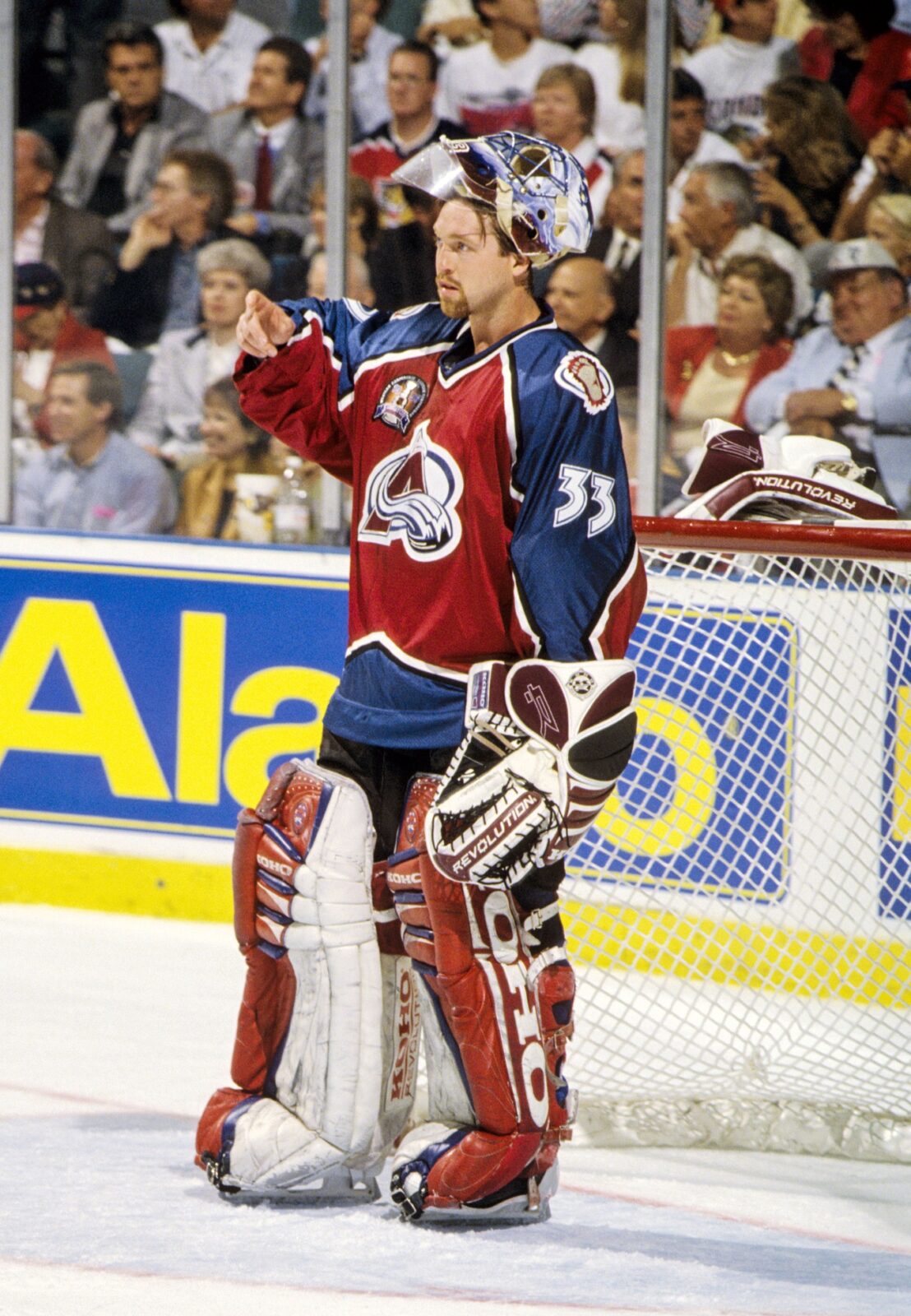
June 1996; Miami, FL; USA; FILE PHOTO; Colorado Avalanche goalie Patrick Roy (33) on the ice during the 1996 Stanley Cup Finals against the Florida Panthers at Miami Arena. Mandatory Credit: RVR Photos-USA TODAY Sports
For the most part, it was.
The Avalanche piled up 104 points in the regular season, beat Vancouver in a tough first-round series, and advanced to meet the Chicago Blackhawks in the Western Conference semifinals. Colorado was trailing 2–1 in the series when Game 4 went into overtime at the United Center, and Ozolinsh so blatantly tripped Chicago’s Jeremy Roenick from behind on a breakaway that the play could have been used as an instruction video for calling for penalty shots. Referee Andy Van Hellemond, destined for retirement at the conclusion of the 1996 playoffs, not only didn’t award Roenick a penalty shot, but he didn’t even call a tripping minor on Ozolinsh. So play continued, the Avalanche won 3–2 in overtime to tie the series, and they then went on to win the fifth and sixth games as well to advance. Had they had lost that Game 4 in Chicago, they would have been down 3–1 in the series.
So the issue, both on that night and later, was: what would have happened if Van Hellemond hadn’t swallowed his whistle, going along with the veteran referees’ standard of not “deciding” a playoff game? After the game, the Blackhawks, including Roenick, were vocal in their criticism of Van Hellemond, and knowing that was the reaction, Roy said it was moot because he would have stopped Roenick on a penalty shot anyway.
This didn’t come out until ten years later, when I heard Roy talk about it at a fan forum in connection with his Hall of Fame induction in Toronto. Roy recalled that on their ride together to the Denver arena the next day for practice, he and Keane talked about a possible response to the Blackhawks.
Roy said Keane told him: “You have two Stanley Cup rings! I think that will be so much better. Tell them you have your Stanley Cup rings plugging your ears!’ That’s how it started.”
The Blackhawks’ media session in Denver came first on that day between games. Having read Roy’s postgame remark, Roenick fired back, bringing up his breakaway goal on Roy earlier in the series. “I like Patrick’s quote that he would have stopped me,” Roenick said. “I just want to know where he was in Game 3. Probably getting his jock out of the rafters of the United Center.”
I was standing near Roy a short time later when team broadcaster Norm Jones played the tape of Roenick’s comment for the goalie. Then Roy went to the microphone to speak at the off day news conference. So he not only had been fed a line by Keane, he had heard Roenick’s specific remark from the earlier media session that day.
When a reporter asked him what he thought of Roenick’s words, both after the game and on the off day, Roy pounced. “I can’t hear Jeremy because I’ve got my two Stanley Cup rings plugging my ears,” he said.
On the VHS tape of Avalanche playoff highlights from that season, the loudest laugh you hear is mine. It completely cracked me up.
The Avalanche went on to knock off the favored Red Wings, who had won sixty-two games in the regular season, in the six-game Western Conference finals, with Lemieux’s hit from behind on Detroit’s Kris Draper fueling what was becoming the NHL’s most venomous rivalry of the 1990s.
Draper suffered a broken jaw and other facial injuries when he slammed into the boards, and it caused the famous lament from Detroit’s Dino Ciccarelli
after he — and the rest of the Wings — went along with protocol and shook hands with Lemieux in the postgame, post-series lines. “I can’t believe I shook
his freakin’ hand,” said Ciccarelli.
I’ve seen a lot worse hits with no injuries sustained. But it indeed was a careless hit, and Lemieux’s reputation for cavalier play added to the reaction. Plus, his lack of sufficient public regret, much less contrition, and his subsequent failure to apologize directly to Draper was indefensible. In that sense, the Wings’ crusade — or at least Darren McCarty’s crusade — was understandable and, to a point, even justifiable.
The Avalanche identity was taking hold. This no longer was the team dropped into Denver from Quebec. It was Colorado’s team. At age twenty-seven, Joe Sakic stepped into the forefront of the local sports scene. He scored two goals in that series-clinching win over the Wings.
“It’s been fun, not only for the players, but for the fans,” Sakic said the night the Avs clinched the series against Detroit and prepared to move on to the Stanley Cup Finals. “I think it’s just great for the city. Early in the year, we weren’t recognized as much. But obviously right now, with the way things are going, everybody is turning into a hockey fan. It’s just great.”
Sakic was a North American success story. His father, Marijan, and his mother, Slavica, journeyed separately from their native Croatia to Canada, where they married and started a family. When he began attending school in the Vancouver area, Sakic already was known for being a young boy of few words, and those few words were in Croatian.
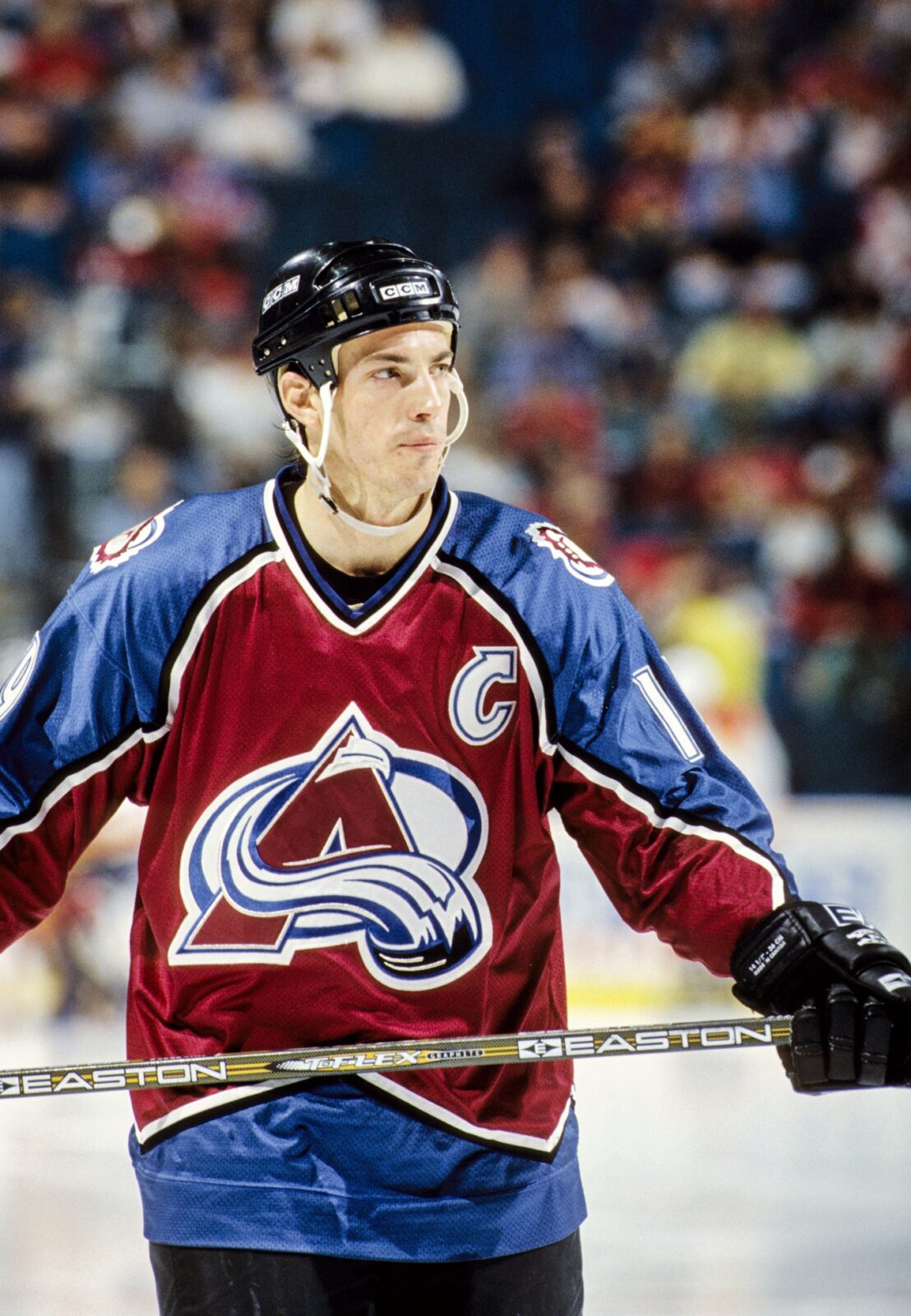
Nov 28, 1997; Miami, FL; USA; FILE PHOTO; Colorado Avalanche forward Joe Sakic (19) on the ice during the 1997-98 season against the Florida Panthers at Miami Arena. Mandatory Credit: RVR Photos-USA TODAY Sports
“Everybody knew English, and I was just starting to learn it,” Sakic told me. Beginning to play at the local rink, a ramshackle complex then known as 4 Rinks, he discovered that hockey was Canada’s Esperanto—a universal language. “It was the worst place in the world,” he said, jokingly of the rink.
Marijan, a stonemason, built a rink in the Sakic backyard. He and Slavica rounded up $300 to buy a family membership to the North Shore Club so their daughter, Rosemarie, could practice figure skating. As part of the deal, Joe and his brother, Brian, also were able to play hockey in the club. Before long, Joe was a prodigy, and he ended up with the Lethbridge Broncos of major junior’s Western Hockey League at the end of the 1985–86 season, then with the relocated Broncos at Swift Current, Saskatchewan, the next season.
On December 30, 1986, the Broncos were headed to Regina on the team bus when the driver lost control in icy conditions. In the resulting crash, four Broncos playing cards at the back of the bus sustained fatal injuries. Sakic, sitting up front, climbed out of the windshield. The rest of that season, the Broncos received standing ovations at every WHL stop.
In June, the Nordiques took Sakic in the first round of the entry draft, and he joined Quebec for the 1988–89 season. Within a few years, he was the captain. In Quebec, he was “Giuseppe” or the “Croatian Sensation” and the face of the franchise. As captain, he always considered another of his nicknames — “Quoteless Joe” — to be a compliment. His captaincy was leading by example and with a barbed sense of humor he turned off when the tape recorders and cameras came on. That was the case during that first playoff run and until the day he retired.
After the victory over the Red Wings, the sweep of the Finals against the overmatched Florida Panthers was anticlimactic. The series-ending Game 4 went into three overtimes until defenseman Uwe Krupp finally scored the game’s only goal. When it suddenly ended, I was in the makeshift press area at ice level, writing and not watching. I didn’t even see a replay of the shot that finally beat Florida goalie John Vanbiesbrouck, because when it happened, I had to plug in a score for an early edition, send that story, then hustle to watch the on-ice celebration, then attend the news conferences, and go to the Avalanche dressing room.
The scene was eerie. The dressing room was tiny and it would have been jammed even if it were only the players, coaches, team staff , and their families.
With the media in there, it was wall to wall, and several players — including Mike Keane and Adam Deadmarsh — at one point sat on top of their lockers, looking down as they swigged champagne and in Keane’s case smoked a cigar.
The Stanley Cup was a goblet. The players were making no moves to take off their uniforms and head to the showers. First, I approached Sakic, whose 18 goals in the postseason were only one short of the NHL record.
“You dream about this moment, and it’s unbelievable,” he said. “We’ve come such a long way in this organization, from the time we started rebuilding in Quebec.”
Two days later, the Avalanche rode in a parade through downtown and then an estimated crowd of 200,000 in the Civic Center Plaza watched Sakic hold the Stanley Cup aloft on the steps of the City and Country Building during the rally and celebration.