
Colorado’s brand new rookie pitching coach, Alon Leichman, stood on the top step of the Rockies’ dugout and leaned on the green-padded railing during the first inning of his first Opening Day at Coors Field. He made eye contact with catcher Hunter Goodman – as the pair were doing between every one of veteran pitcher Michael Lorenzen’s deliveries – and made a fist (presumably the sign for zero), followed by holding up a select number of fingers. In this three-sign sequence, two of the numbers are decoys and one is indicating the selected pitch. This routine was repeated prior to every pitch. Like most coaches in high school and college baseball are doing now, the coach was signaling in from the dugout the next pitch he wanted Lorenzen to throw.
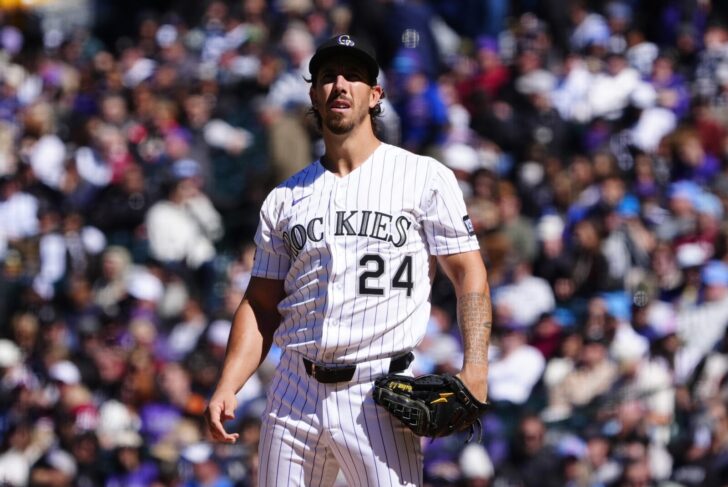
Lorenzen, a 12-year veteran who threw a no-hitter for Philadelphia back in 2023, got the signal from Goodman via the electronic means being used in MLB these days. He went into his delivery. Already trailing the visiting Phillies 3-0 in his first start in purple pinstripes, Lorenzen had two men on, and needed to make a big pitch to get out of the jam against former teammate Brandon Marsh.
Thanks to the Houston Astros’ sign-stealing scandal that created an uproar back in 2017 and 2018, Major League Baseball no longer has the catcher simply put down one, two or three fingers to signal which pitch to throw (and with a runner on second base, a similar one, two or three fingers down signaling sequence used to be used.) The entire baseball industry adopted the use of electronic communications between pitcher and catcher prior to the 2022 season. “PitchCom” has eliminated the type of visual theft that the Astros employed prior to it being implemented five years ago.
But the 2026 Rockies have taken things a step further. After teasing the idea of the coach calling the pitches from the dugout when they first hired Leichman during the offseason, they have indeed put it into practice at the start of the 2026 season.
So in this tense first-inning situation, the 12-year veteran was being forced to lean on the 36-year-old coach – who never played or pitched professionally in North America – to instruct him on which of his pitches should be thrown to Marsh in that situation. Rockies pitchers do have the authority to shake off the call that has come in from the dugout if they don’t want to throw that pitch. Lorenzen didn’t.
One can understand why. Would you shake off your boss? If he shakes off the pitch and decides to throw something different, and that pitch gets hit in the gap or worse, he’s going to have to answer to not just Leichman, but manager Warren Schaeffer and the newly analytics-driven front office as well. From the bosses’ perspective, Leichman and his iPad have been armed with data that’s been gathered on both his pitcher and the hitter, and his analytics were telling him that Lorenzen should throw a letter-high fastball to Marsh. Goodman gave his pitcher the sign and set a target accordingly.
Lorenzen followed orders and threw a fastball that he didn’t get quite high or inside enough. He missed his location by roughly eight inches, throwing an inside fastball that may or may not have even been called a strike. Marsh swung and connected. The ball landed 454 feet away, midway up the second deck in right field. Suddenly the Rockies trailed 6-0. They’d go on to lose the home opener, 10-1.
Apparently, analytics told Leichman that the best way to get Marsh out in that situation was to throw him a fastball at the top of the strike zone. It didn’t work out that way.
This is the Rockies’ pitchers dilemma (as if they don’t already have enough to worry about). They have a young pitching coach with no American professional playing experience – but who is armed with state-of-the-art technology and all the current data – instructing them as to what they should throw to many of the same hitters they’ve likely already faced in a real game a dozen or more times. They can shake it off and take the heat if they fail, or they can follow instructions… and still take the heat if or when they fail.
Even though he called the pitch, it wasn’t Leichman’s name on the pitch that became a souvenir, it was Lorenzen’s.
Unless you’ve stood on that mound in that situation, you can’t conceive of the type of all-in conviction a pitcher has to have mentally in order to throw a single big-league pitch. He has to believe in that pitch completely for it to be successful. And if it’s not, it’s the pitcher – not the catcher or the coach who called the pitch – who has to wear it.
Lorenzen wasn’t very good on that chilly Friday afternoon, and certainly that one bad pitch wasn’t to blame for his rough outing or the Rockies’ loss. But what if next time he takes the hill, that one bad pitch – that he didn’t choose to throw on his own – costs he and his team the game?
Who will wear that?