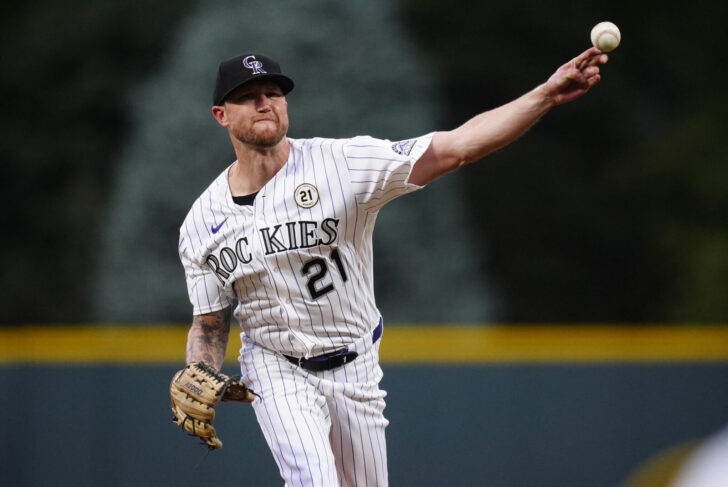
Kyle Freeland has an unusual legacy.
Few in MLB history, let alone Colorado Rockies history, can lay claim simultaneously to being among the most important players in the history of the franchise and also arguably just an average player.
This dynamic is captured by two stats.
His ERA+ of 103 suggests that, for his career, he has been roughly league average. Meanwhile, his WAR of 19.3 places him at the very top of the Rockies all-time charts. So, how did a roughly league average pitcher accumulate more total value than any other pitcher in Rox history? In a word, longevity.
And therein lies the key question of Freeland’s career. Will his longevity be treated as an accomplishment or as an asterisk?
See, Freeland’s best argument for being among the “best” pitchers in Rockies history is wrapped up in counting stats. He’s the all-time leader in games started (255 to Aaron Cook’s 205) and innings pitched. As of writing, he sits just 21 strikeouts behind German Marquez for the top spot in that category. Those two are the only pitchers in club history to cross the 1,000 strikeout mark.
His case is quite similar to Charlie Blackmon’s on the position player side. Blackmon sits in second place in most offensive stats in franchise history but few would place him in second place on the all-time franchise rankings.
Players like Larry Walker, Nolan Arenado, Troy Tulowitzki, and Carlos Gonzalez all had more star power than Blackmon. All of those players at their best were, frankly, better than Chuck Nazty. Still, Chuck managed to stay healthy, stay on the field, and stay on the team. So one might argue he is the second most valuable or maybe the second most iconic player in franchise history.
Freeland has done the same on the mound. Except in his case, there is no Helton. There is not one pitcher who is clearly head-and-shoulders ahead of everyone else in every stat.
Ubaldo Jimenez is more comparable to Walker. At his best, he was the best. It just didn’t last long. His 128 ERA+ is way ahead of (believe it or not) Tyler Chatwood’s 114 in second place. Despite only pitching five seasons in Colorado, Jimenez is still second in WAR behind Freeland. So, Jimenez easily wins the “peak” argument but isn’t even in the “longevity” conversation.
There are only two pitchers who can compete with Freeland here; Aaron Cook and Jorde de la Rosa.
Spend some time on the internet discussing this issue and you will find Rockies fans have much love in their hearts for these two. Seemingly forever, Cook was the model of consistency. He was the guy who lacked top-end stuff, never piled up the strikeouts, but was the iron horse of altitude. He held most of the counting stat records until Freeland started knocking them down in the last few years.
De la Rosa, on the other hand, doesn’t hold many franchise records but established himself as (still) the undisputed King of Coors Field. His winning percentage in Denver, Colorado was 73 percent. Just… wow.
Some would argue that not only is Freeland not the best pitcher in Rockies history, but he also doesn’t even belong on their Mt. Rushmore. Jimenez, Cook, de la Rosa, and maybe German Marquez or Jon Gray could all argue for a spot.
To come back to the rate stat of ERA+, each of those players ranks better than Freeland. So, what truly is the value of longevity?
A cynical answer is that there isn’t any. Freeland only holds franchise records because he stuck around a long time, they’ll say. Other players didn’t ask to be traded or start their careers on other teams. Cook had his career sadly cut shorter by blood clot issues otherwise Freeland might still be chasing him in several categories.
Another thing that hurts Freeland’s case is that his overall value was heavily front-loaded. Of his 19.3 career WAR, 11.2 of it came in his first two years. Our recency bias and current memory see a pitcher who has been hovering around the league average for five years.
Both Cook and de la Rosa spread out their value, providing ups and downs throughout their careers that, once crystallized, seem to sit favorably with the fanbase. Freeland started hot and has, for quite some time since, been decent at best. Typically posting a positive WAR, he hasn’t posted an ERA+ above 102 since 2021.
Of course, Freeland has a few other intangibles going for him. You may have heard that he’s from here.
Still, it might be worth considering that longevity is more than “sticking around.” Coors Field is the toughest environment to pitch in MLB. And few have endured. Whether it be the wear and tear of altitude, the mental challenge of dealing with the nuances of the park, or just the natural overturn of the modern game, almost nobody has managed to just “stick around” here for very long. Because it’s hard. Really hard.
Sure, Freeland had some built-in advantages for getting to stick around. And who knows how much longer he may get to do so. Either way, his unusual legacy is already secure.
Is he the best pitcher in franchise history? No.
Is he the most valuable pitcher in franchise history? Debatable.
Is he the human being who endured the toughest challenge in modern pitching better than any other human being?
Without question.